Current condition
Record the drawing revision, ferrule variant, supplied bulk condition and actual sample identity. Identify nested examples, existing edge damage and any problem at the current receiving-tool handover.
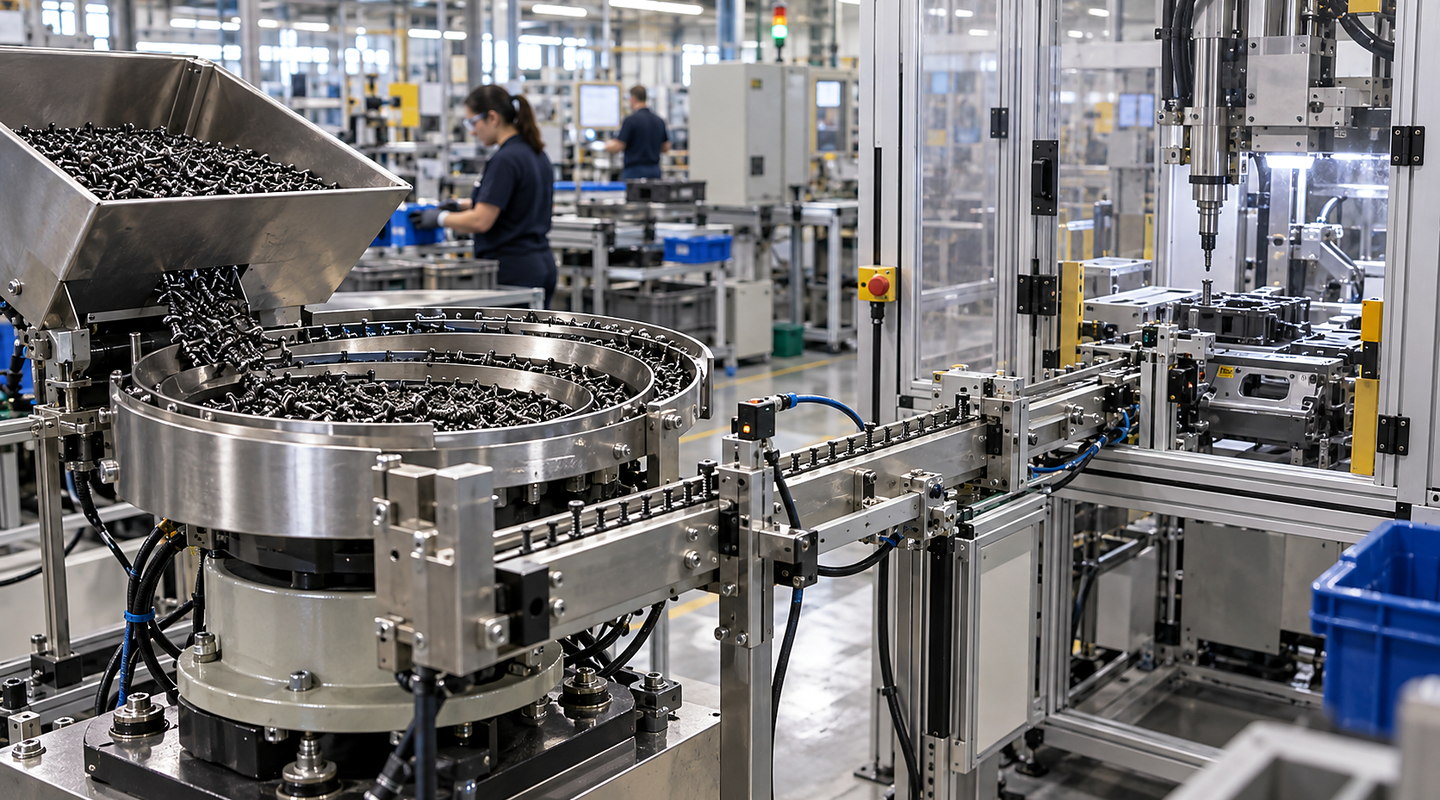
Prepare ferrule samples and drawings covering bore, flange, collar, leading end, nested pairs and edge condition before trials at the assembly-tool interface.
Ferrules with similar outside dimensions may behave differently because of their bore, flange, edge or insulating collar. Identify the complete family and supplied bulk condition. Trial nested pairs, the required leading end and handled-part condition before accepting delivery into the actual assembly tool.
Prepare the ferrule family checklist and receiving-tool handover plan. Do not extend a permitted tooling family from a single nominal diameter or the easiest demonstration sample.
Plan ferrule feeders around real component variation, bulk condition, orientation, usable delivery rate and the downstream interface. Discuss representative part trials with Sorting Solutions. Use this guide to resolve component geometry and variation for ferrule feeding & presentation before it limits the final system.
Discuss your application

Record the drawing revision, ferrule variant, supplied bulk condition and actual sample identity. Identify nested examples, existing edge damage and any problem at the current receiving-tool handover.
Include outside diameter, bore, length, flange, collar and material variations, including the smallest and largest ferrules. Represent permitted supplier changes and normal bulk packaging and loading quantity.
Connect the ferrule range to separation, leading-end selection, bore and edge protection, final support and assembly clearance. Identify the adjustments and change parts used for each trial rather than assuming a common nominal diameter means common tooling.
Provide outside diameter, bore, length, flange and insulating-collar dimensions for each ferrule variant. Identify drawing revisions, material and permitted supplier changes; a shared nominal diameter does not establish one tooling setup.
Identify restrictions on contact with the bore, coating and formed rim. Use incoming and handled parts to compare edge condition by the same agreed method, including pinching, tilting or marking at transitions and the final stop.
Use the normal bulk packaging and loading quantity, with known nested or telescoped pairs and collars that lodge against neighbours. Record how separation, rejection or a stop on an unresolved pair will be assessed before the assembly tool.
Define which end must lead and how a flange, collar, chamfer or formed edge relates to the insertion datum. Confirm whether both directions are functionally acceptable before adding orientation work. Measure usable delivery at the receiving process.
Provide the actual nest, mandrel, insertion-tool or pick-point drawing. Agree support, clearance and confirmation before release, then trial the handover with the downstream cycle, including a late request or one that is withdrawn.
Trial the smallest and largest ferrules, normal refill and restart after the buffer fills. Record double feeds, orientation failures, damage and interventions separately. Identify change parts and adjustments, then check the first released ferrule after changeover.